Digital dental X-rays reveal problems hidden beneath tooth surfaces and gum tissue that visual examination alone cannot detect. At Dental Sedation Ottawa, we use state-of-the-art digital radiography technology that provides clearer images with 90% less radiation than traditional film X-rays—keeping you safe while ensuring accurate diagnosis and effective treatment planning.
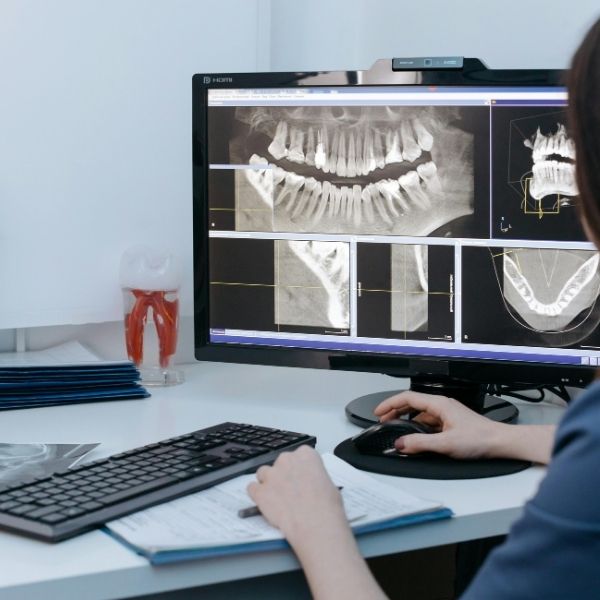
Imagine trying to diagnose car engine problems by only looking at the exterior—you'd miss critical issues happening inside. Dental X-rays work the same way for your mouth. While clinical examination reveals much, X-rays expose problems developing between teeth, beneath fillings, in tooth roots, inside bone, and under the gum line that are completely invisible to the naked eye.
Without X-rays, dentists would miss 40-60% of cavities, infections, bone loss, and other significant problems until they become painful emergencies requiring extensive treatment. Early detection through regular X-rays means simpler, less expensive, and more successful treatment.
Modern digital X-ray technology has revolutionized dental imaging. These advanced systems capture detailed images instantly on a computer screen, allow enhancement and magnification for better diagnosis, reduce radiation exposure by 80-90% compared to traditional film, and eliminate chemical processing that harmed the environment.
For patients who experience anxiety about X-rays, our sedation options can make the imaging process completely comfortable and stress-free.
At our Ottawa dental clinic, we understand that X-ray procedures can trigger anxiety—whether from past uncomfortable experiences with gagging on X-ray sensors, fear of radiation exposure, claustrophobia with the equipment, or general dental fear. We make comfort and safety our priorities through modern technology and sedation dentistry options.
Mild relaxation for patients with minimal anxiety or gag reflex concerns. You stay fully awake and breathe normally. Perfect for routine X-rays. Learn more about nitrous oxide
Medication taken before your appointment creates drowsiness and reduces anxiety significantly. Great for moderate dental fear or strong gag reflex. Explore oral sedation
Deeper sedation for high anxiety or patients requiring extensive imaging. Continuous monitoring throughout ensures safety. Discover IV sedation
Complete sleep with zero awareness, administered by board-certified medical anesthesiologists (Dr. Hesham Talab, MD MSc PhD FRCPC FASE and Dr. Asad Mirghassemi, MD MSc FRCPC). Best for severe dental phobia or special needs patients. Hospital-grade safety right in our clinic. Learn about general anesthesia
Our digital sensors are smaller and more comfortable than traditional film. We use positioning aids that reduce gagging. Child-sized sensors accommodate young patients. Images appear instantly—no waiting with uncomfortable sensors in place.
Questions? We're here to help.
We use several types of digital X-rays depending on what information your dentist needs for accurate diagnosis and treatment planning.
Show upper and lower teeth in one area, revealing cavities between teeth and bone levels around teeth. Typically taken during check-ups to detect decay early. We capture 4 bitewings covering all back teeth (2-3 minutes).
Show entire tooth from crown to root tip and surrounding bone. Used to diagnose infections, abscesses, impacted teeth, root problems, and bone disease. Individual targeted images of problem areas (1 minute per tooth).
Single wide image showing all teeth, both jaws, TMJ joints, sinuses, and surrounding structures in one picture. Useful for treatment planning, evaluating wisdom teeth, detecting jaw problems, and screening for pathology. Rotating machine circles your head while you remain still (10-15 seconds).
Complete set of 18-20 X-rays capturing every tooth from multiple angles. Provides comprehensive baseline documentation for new patients or those with extensive dental needs. Taken every 3-5 years (15-20 minutes).
Three-dimensional volumetric imaging showing teeth, bone, nerves, and sinuses in 3D. Essential for implant planning, impacted tooth evaluation, and complex treatment. Available when needed; we refer to specialized imaging centers for this advanced scan.
Your dentist recommends specific X-rays based on your age, oral health status, symptoms, disease risk factors, and treatment needs. We never take unnecessary images—every X-ray serves a specific diagnostic purpose.
Ready to take the next step? Our team is here for you.
Digital dental radiography uses the same basic principle as traditional film X-rays—radiation passes through tissues, creating an image based on varying absorption—but replaces film with electronic sensors that are far more sensitive and efficient.
A small sensor (about the size of a thick postage stamp) is positioned in your mouth next to the teeth being imaged. You gently bite down or hold it in place. The X-ray tube aims at the sensor from outside your mouth. When activated, the X-ray beam passes through your teeth and tissues in a fraction of a second—typically 0.1 to 0.3 seconds per image.
The sensor instantly captures the image and transmits it to a computer screen where it appears within seconds. The dentist can immediately view, enlarge, adjust brightness and contrast, measure precisely, and compare with previous X-rays side-by-side. No waiting for film development, no chemical processors, no disposal issues.
For panoramic X-rays, you stand or sit with your chin on a rest while the X-ray source and detector rotate around your head in a 15-second arc. The machine stitches multiple images together creating one complete view of your entire oral and maxillofacial region.
Advanced software allows us to enhance images, highlight problem areas with color, measure bone levels precisely, and detect subtle changes over time that might indicate developing disease.
Ready to learn more? Schedule a consultation today.
Many patients worry about radiation exposure from dental X-rays. The truth is that digital dental X-rays expose you to extremely low radiation levels—far less than many everyday sources.
Digital X-rays use 80-90% less radiation than traditional film X-rays. A complete dental X-ray series exposes you to less radiation than a single day of natural background radiation from cosmic rays, radon gas, and terrestrial sources.
Children receive lower radiation doses through specialized pediatric settings and smaller, child-specific sensors. Pregnant women typically avoid X-rays except for dental emergencies, though radiation exposure from dental X-rays poses minimal risk to developing babies, especially with lead apron shielding.
The benefits of early disease detection through appropriate X-rays far outweigh the minimal radiation risk. Undetected dental infections, cavities, and bone loss pose far greater health threats than the negligible radiation exposure from diagnostic imaging.
Have questions? We'd love to hear from you.
X-ray frequency depends on your individual oral health status, age, disease risk factors, and dental history. We never take X-rays "just because it's been a year"—every image must have a specific diagnostic purpose.
Factors increasing X-ray frequency include history of frequent cavities, active gum disease, dry mouth from medications, smoking or tobacco use, diabetes, and complex dental work requiring monitoring.
Your dentist determines appropriate X-ray intervals based on your unique situation, balancing diagnostic needs with radiation minimization principles.
Digital X-rays provide critical diagnostic information impossible to obtain through visual examination alone. They reveal:
This comprehensive diagnostic information allows your dentist to detect problems early, create accurate treatment plans, and monitor healing after procedures—ultimately saving you time, money, and discomfort through early intervention.
Digital X-ray costs vary by type and number of images:
| Single bitewing X-ray | $25-35 |
| Set of 4 bitewings | $80-120 |
| Periapical X-ray | $30-40 |
| Full mouth series | $125-200 |
| Panoramic X-ray | $100-150 |
Most dental insurance plans cover diagnostic X-rays at 80-100% as part of preventive care when taken at appropriate intervals. Annual or biennial limits typically allow necessary imaging for monitoring oral health. We provide direct billing to major insurers and accept the Canadian Dental Care Plan (CDCP) for eligible patients.
X-rays represent an essential, cost-effective diagnostic tool. Detecting a small cavity early through a $30 X-ray prevents a $2,000 root canal and crown later. Identifying bone loss early prevents $10,000 in periodontal surgery and implant costs.
Our patients consistently rate us 5 stars for gentle, anxiety-free care. Read verified patient experiences on Google.
View All Reviews on GoogleDentist Referrals Welcome: We collaborate with referring dentists throughout Ottawa and Eastern Ontario for dental sedation cases.
We welcome patients from throughout Ottawa including Kanata, Nepean, Orléans, Stittsville, Manotick, and Greely, as well as Eastern Ontario communities (Rockland, Embrun, Russell, Winchester, Kemptville, Carleton Place, Arnprior, Renfrew, Pembroke, Cornwall, Hawkesbury) and West Quebec (Gatineau, Aylmer, Hull, Chelsea, Wakefield, Buckingham).
