Dental sealants provide powerful protection against tooth decay by sealing the deep grooves in back teeth where cavities most commonly develop. At Dental Sedation Ottawa, we make sealant application comfortable and anxiety-free through sedation options—from gentle relaxation to complete sleep—so children and adults can receive this proven preventive treatment without fear or discomfort.
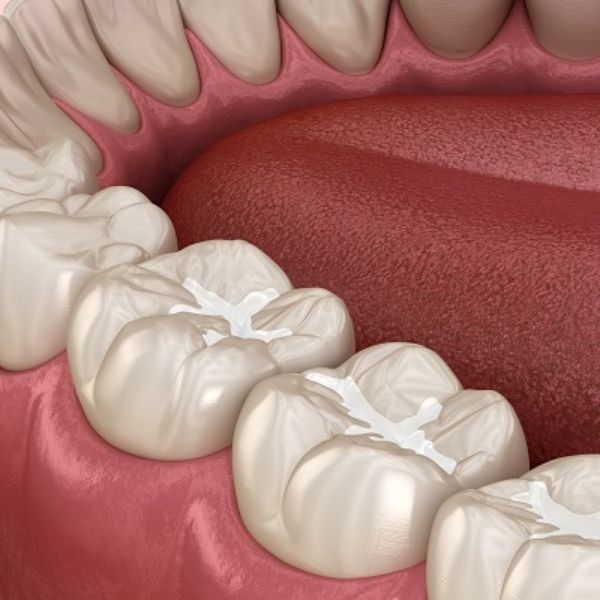
Think of dental sealants as a protective shield for your teeth—specifically for the chewing surfaces of back teeth (molars and premolars) where 80-90% of cavities develop in children and teens. These areas have deep pits and grooves that trap food particles and bacteria that toothbrush bristles simply cannot reach effectively.
A sealant is a thin plastic coating (typically clear or tooth-colored) that flows into these vulnerable grooves and hardens into a smooth, protective barrier. Once sealed, food and bacteria can no longer get trapped in the deep crevices, dramatically reducing cavity risk. Research shows sealants reduce decay in molars by nearly 80% in the first two years after application and continue providing protection for 50-70% for four years or longer with proper care.
Originally developed for children's teeth, sealants have proven so effective that many dental professionals now recommend them for cavity-prone adults too. The Canadian Dental Association and American Dental Association strongly endorse sealants as one of the most effective preventive measures available.
For children or adults with dental anxiety, our sedation options ensure comfortable sealant application—especially when sealing multiple teeth or combining with other preventive treatments in one visit.
At our Ottawa dental clinic, we understand that any dental procedure can trigger anxiety—even quick, painless treatments like sealants. Children may feel nervous about unfamiliar procedures, while adults with dental phobia appreciate sedation support for even simple preventive care. We make comfort our priority through evidence-based sedation dentistry options.
Mild relaxation perfect for children and adults with minimal anxiety. You or your child stays awake, breathes normally, and effects wear off within minutes. Ideal for routine sealant application. Learn more about nitrous oxide
Medication taken before the appointment creates drowsiness and reduces anxiety significantly. Great for nervous children, anxious adults, or when sealing multiple teeth. Little memory of the procedure afterward. Explore oral sedation
Deeper sedation for high anxiety or when combining sealants with multiple other treatments. Continuous monitoring ensures safety. Discover IV sedation
Complete sleep with zero awareness, administered by board-certified medical anesthesiologists (Dr. Hesham Talab, MD MSc PhD FRCPC FASE and Dr. Asad Mirghassemi, MD MSc FRCPC). Best for severe dental phobia, very young children, special needs patients, or comprehensive treatment including sealants plus fillings and other work. Hospital-grade safety right in our clinic. Learn about general anesthesia
With appropriate sedation, we can seal all recommended teeth—typically 4-8 molars—in one comfortable appointment. For children requiring other dental work, we often apply sealants during the same sedated visit for maximum efficiency and minimal anxiety.
Questions? We're here to help.
Dental sealants benefit anyone with deep grooves in their teeth, but certain groups benefit most from this proven preventive treatment.
Primary candidates for sealants. Permanent molars erupt around ages 6 and 12, making these ideal times for protection. The first few years after eruption represent the highest cavity risk period. Sealants applied soon after permanent molars come in provide maximum protection during these vulnerable years.
Excellent candidates if they have deep grooves, history of cavities, or difficulty keeping molars clean. Many adults never received sealants as children and benefit from this protection now. Adult teeth respond just as well to sealants as children's teeth.
Those with previous decay, poor oral hygiene, dry mouth from medications, frequent snacking habits, or difficulty accessing dental care benefit tremendously from sealants' extra protection.
Individuals with physical, developmental, or cognitive challenges who struggle with thorough brushing greatly benefit from sealants reducing cavity risk in hard-to-clean areas.
Sealants work best when applied to cavity-free teeth. If a tooth already has a cavity, it needs a filling first. However, sealants can be applied over very early decay (small white spots) to stop progression and remineralize the area.
Ready to take the next step? Our team is here for you.
Applying dental sealants is one of the simplest, most comfortable dental procedures—completely painless with no drilling, shots, or anesthesia required (unless combined with other treatments needing numbing). Most children and adults tolerate sealants easily, though our sedation options provide extra comfort when needed.
The dentist or hygienist begins by thoroughly cleaning the tooth surface to remove all plaque and food debris. A rotating brush with pumice paste scrubs the grooves clean—this feels like tooth polishing and causes no discomfort.
Next, a mildly acidic solution (etchant) is applied to the chewing surface for 15-30 seconds. This roughens the enamel microscopically, allowing the sealant to bond firmly. The tooth is rinsed thoroughly and dried completely—moisture prevents proper bonding.
The liquid sealant material (clear or tooth-colored resin) is carefully painted into the grooves and pits using a small brush. The dentist ensures complete coverage of all vulnerable areas while keeping the sealant thin and smooth.
A special blue curing light is positioned over the tooth for 20-30 seconds. This light hardens the liquid sealant into a durable plastic coating. The dentist checks the bite to ensure the sealed tooth fits comfortably with opposing teeth and makes any necessary adjustments.
That's it! The entire process takes 5-10 minutes per tooth, and you can eat immediately afterward. No numbness, no pain, no recovery period.
Time Required: 5-10 minutes per tooth; 30-45 minutes to seal all four permanent molars.
Ready to learn more? Schedule a consultation today.
Dental sealants are remarkably durable considering their thin profile. Research shows that properly applied sealants last an average of 5-10 years, with many lasting much longer. Some sealants remain intact and functional for 15+ years.
During checkups, your dentist examines sealants for chips, wear, or loss. Damaged areas can be easily repaired by cleaning and reapplying sealant material—a simple, painless five-minute procedure. Even partially worn sealants continue providing protection in remaining sealed areas.
Sealants eventually wear away naturally from chewing forces, acidic foods, and time. By then, most patients have passed the highest-risk years for pit and fissure cavities. Many adults who received childhood sealants never develop cavities in sealed teeth even after sealants wear away because healthy habits and maturation reduce cavity risk.
Have questions? We'd love to hear from you.
Decades of research consistently demonstrate that dental sealants are one of the most effective preventive treatments available. Multiple long-term studies document their remarkable cavity prevention capabilities.
The Centers for Disease Control (CDC) reports that school-age children without sealants have almost three times more cavities than children with sealants. Low-income children especially benefit—those who receive sealants have significantly better oral health and fewer emergency dental visits than unsealed peers.
Sealants provide excellent value considering their low cost, long lifespan, and prevention of expensive restorative treatment. A $50 sealant that lasts 7-10 years prevents multiple $200-300 fillings over that same period.
Both sealants and fluoride prevent cavities, but they work differently and protect different tooth surfaces. Using both together provides the most comprehensive cavity prevention.
Fluoride: Strengthens enamel throughout the entire tooth, making it more resistant to acid attacks from bacteria. Works primarily on smooth surfaces (front teeth, sides of back teeth). Applied through toothpaste, drinking water, and professional treatments.
Sealants: Physically block bacteria and food from deep grooves on chewing surfaces where fluoride has limited effectiveness. Target the specific areas where 80-90% of children's cavities develop.
Think of fluoride as strengthening your armor while sealants add a protective shield to your most vulnerable spots. Together, they dramatically reduce cavity risk across all tooth surfaces. The American Academy of Pediatric Dentistry recommends both fluoride treatments and sealants for optimal cavity prevention in children.
Dental sealants typically cost $40-60 per tooth. Sealing all four permanent molars costs $160-240. This one-time investment provides years of protection and prevents far more expensive fillings ($200-300 each) that would otherwise likely develop in those vulnerable grooves.
Most dental insurance plans cover sealants at 80-100% for children through age 14-18. Adult sealants may be covered at 50-80% or considered an optional benefit depending on the specific plan. We provide direct billing to major insurers and accept the Canadian Dental Care Plan (CDCP) for eligible patients.
Many public health programs and schools offer free or low-cost sealants for low-income children because of their proven effectiveness in preventing childhood cavities. Ask us about available community resources if cost is a concern.
The return on investment is clear: spending $200 to seal four molars prevents an estimated $1,200-2,000 in fillings, root canals, and crowns over a child's adolescence. Sealants rank among the most cost-effective preventive treatments available.
Our patients consistently rate us 5 stars for gentle, anxiety-free care. Read verified patient experiences on Google.
View All Reviews on GoogleDentist Referrals Welcome: We collaborate with referring dentists throughout Ottawa and Eastern Ontario for dental sedation cases.
