Missing teeth affect more than just your smile—they impact chewing, speech, and remaining teeth stability. Dental bridges offer a fixed, non-removable solution that restores function and confidence without implant surgery. At Dental Sedation Ottawa, we create beautiful, comfortable bridges while offering comprehensive sedation options to eliminate any fear or anxiety from the process.
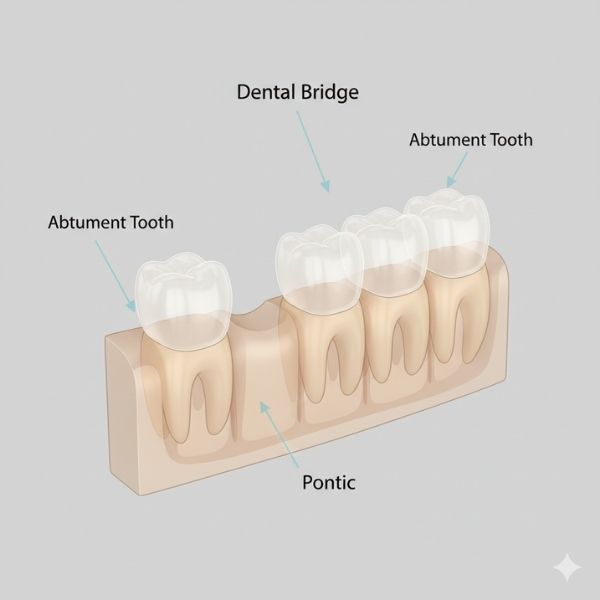
A dental bridge is a fixed restoration that literally "bridges" the gap left by one or more missing teeth. Think of it like a literal bridge spanning a gap—the replacement teeth (called pontics) are anchored to the natural teeth on either side (called abutment teeth).
Unlike removable dentures that you take out daily, bridges are permanently cemented in place. You can't remove them—they become a fixed part of your mouth, functioning just like natural teeth for chewing, speaking, and smiling.
Modern dental bridges are crafted from tooth-colored materials (porcelain or ceramic) that look completely natural. Most people won't know you have dental work—they'll just see a complete, healthy-looking smile. With proper care, bridges typically last 10-15 years or longer.
Bridge procedures involve preparing teeth (similar to crowns) and require multiple appointments, which can trigger dental anxiety. At our Ottawa dental clinic, we believe anxiety should never prevent you from replacing missing teeth and restoring your smile.
Mild relaxation helps you stay calm during bridge preparation and placement. You remain fully aware but comfortable, with effects wearing off within minutes. Learn more about nitrous oxide
Medication taken before your appointment creates drowsiness and significantly reduces anxiety. Ideal for patients nervous about multiple-tooth preparation. Explore oral sedation
Deeper sedation with continuous monitoring throughout treatment. Perfect for longer bridge preparation appointments or high anxiety levels. Discover IV sedation
Complete unconsciousness with zero awareness, administered by board-certified medical anesthesiologists (Dr. Hesham Talab, MD MSc PhD FRCPC FASE and Dr. Asad Mirghassemi, MD MSc FRCPC). Best for severe dental anxiety or complex bridge cases. Hospital-grade safety in our dental clinic. Learn about general anesthesia
With appropriate sedation—especially IV sedation or general anesthesia—we can prepare multiple bridges in a single appointment. This dramatically reduces the number of visits needed and means only one recovery period instead of several.
Questions? We're here to help.
Dentists recommend bridges when you're missing one to three consecutive teeth and have healthy, strong teeth on either side of the gap. Bridges are particularly appropriate when:
One replacement tooth (pontic) supported by crowns on both adjacent teeth. The most common bridge type.
Longer bridges can span gaps of two or three missing teeth, though they require stronger anchor teeth and careful bite management.
Bridges work excellently for visible front teeth where aesthetics matter most.
Bridges restore chewing function for missing molars and premolars.
When Other Options Work Better: Multiple missing teeth throughout the mouth often need partial dentures. If supporting teeth are weak or heavily damaged, implants may provide more stable support.
The most common type. Replacement teeth are fused between two crowns that fit over the abutment teeth on either side. Very strong and durable for back teeth.
Used when teeth exist on only one side of the gap. Less common and typically reserved for low-stress areas like front teeth.
Metal or porcelain framework bonded to backs of adjacent teeth. More conservative (doesn't require full crowns) but less strong—best for front teeth with light chewing forces.
Dental implants replace missing teeth's roots, and the bridge anchors to implants instead of natural teeth. Doesn't require altering natural teeth but involves surgical placement. Learn more about dental implants
We discuss all appropriate options during your consultation, explaining the pros and cons of each based on your specific situation.
Bridge placement typically requires two appointments spaced 2-3 weeks apart.
We begin by administering your chosen sedation option. Once comfortable and relaxed, we numb the abutment teeth areas completely. The dentist then carefully reshapes both abutment teeth—removing some enamel to create space for crowns to fit over them. This preparation is similar to preparing teeth for individual crowns.
We take detailed impressions (or digital scans) of the prepared teeth and the gap. These impressions go to our skilled dental laboratory where technicians craft your custom bridge as one continuous piece. We carefully select porcelain shades to match your natural teeth perfectly.
Before you leave, we place a temporary bridge to protect the prepared teeth and maintain appearance and function while the permanent bridge is being made. This temporary bridge should work fine for normal eating (just avoid very sticky or hard foods).
Typically 2-3 weeks for laboratory fabrication of your custom bridge.
At your return visit, we remove the temporary bridge and clean the prepared teeth thoroughly. We try in your new permanent bridge, checking fit, bite, appearance, and shade match. We make any necessary adjustments and ask for your approval.
Once everything is perfect, we permanently cement the bridge in place and polish it to a natural shine. With sedation, both appointments are comfortable and anxiety-free.
Time Required: First appointment 1.5-2.5 hours; second appointment 45-90 minutes.
Ready to get started?
Avoid very hard or sticky foods for the first day after permanent bridge placement. Some sensitivity around gum lines is normal for a few days. The bridge itself won't be sensitive, but natural abutment teeth may respond to temperature initially.
Bridges require diligent daily cleaning to prevent decay and gum disease:
The space under replacement teeth must be cleaned daily to prevent food buildup, bad breath, and decay of supporting teeth. We'll demonstrate proper technique at your final appointment.
With excellent home care and professional maintenance, bridges typically last 10-15 years. Many patients get 20+ years from high-quality bridges. Signs a bridge may need attention include:
Regular checkups allow us to monitor bridge and supporting teeth health, catching problems early.
Call us immediately at (613) 482-0501 if: Your bridge feels loose, breaks, or you experience persistent pain.
Ready to take the next step? Our team is here for you.
Dental bridges typically cost starting at $2,500-5,000 depending on bridge length (number of missing teeth) and materials used. A three-unit bridge (replacing one missing tooth) generally costs $2,500-3,500. Longer bridges cost proportionally more.
Most dental insurance plans cover bridges at 50% for medically necessary tooth replacement. We provide direct billing to major insurance companies and accept the Canadian Dental Care Plan (CDCP).
When comparing costs, consider that bridges last 10-15+ years and don't require the surgical procedures that dental implants do. For many patients, bridges provide excellent long-term value for replacing missing teeth.
Our patients consistently rate us 5 stars for gentle, anxiety-free care. Read verified patient experiences on Google.
View All Reviews on GoogleDentist Referrals Welcome: We collaborate with referring dentists throughout Ottawa and Eastern Ontario for complex bridge cases and sedation dentistry. Learn about our referral program
We welcome patients from throughout Ottawa including Kanata, Nepean, Orléans, Stittsville, Manotick, and Greely, as well as Eastern Ontario communities (Rockland, Embrun, Russell, Winchester, Kemptville, Carleton Place, Arnprior, Renfrew, Pembroke, Cornwall, Hawkesbury) and West Quebec (Gatineau, Aylmer, Hull, Chelsea, Wakefield, Buckingham).
