The deep grooves and pits on the chewing surfaces of back teeth are where most cavities start — especially in children. Dental sealants are thin, protective coatings that seal these vulnerable surfaces, preventing food particles and bacteria from settling into grooves that are nearly impossible to clean with a toothbrush alone. At Dental Sedation Ottawa, sealant application takes just minutes per tooth, requires no drilling or anesthesia, and is available with sedation for children or adults who feel anxious about any dental procedure.
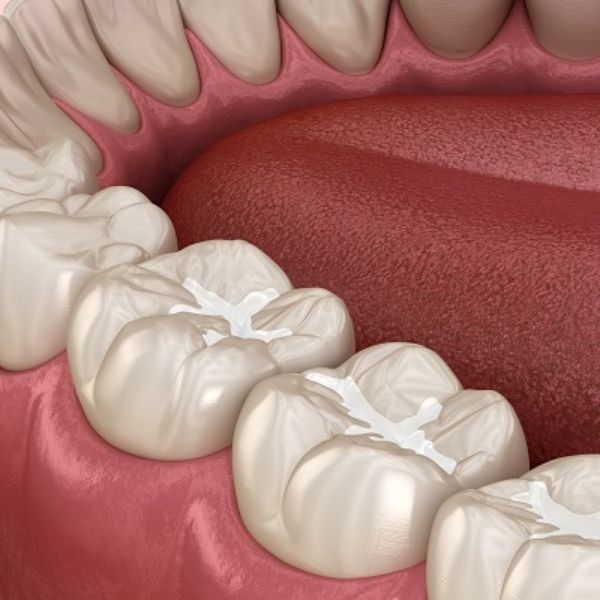
Dental sealants are thin, BPA-free resin coatings painted onto the chewing surfaces (occlusal surfaces) of premolars and molars. These back teeth have natural grooves, pits, and fissures that trap food particles and bacteria — creating the perfect environment for cavity formation.
Even with excellent brushing habits, toothbrush bristles simply cannot reach the bottom of these narrow grooves. Some fissures are narrower than a single toothbrush bristle. Sealants fill these grooves with a smooth, protective barrier that keeps bacteria and food debris out.
The sealant material bonds directly to the tooth enamel and hardens under a curing light in seconds. Once applied, sealants create a smooth surface that's easy to clean and resistant to decay. They're invisible to others — the material is tooth-coloured or clear — and you can't feel them once they're in place.
Sealants are one of the most effective, evidence-based preventive measures in all of dentistry. The CDC reports that sealants prevent 80% of cavities in the first two years after application and continue providing protection for up to 10 years with proper monitoring.
Sealant application is one of the quickest and most comfortable dental procedures — no drilling, no needles, no anesthesia needed. But for anxious patients, we make it even easier.
These "six-year molars" erupt behind the baby teeth and are the most cavity-prone teeth in the mouth. Sealing them immediately upon eruption provides years of protection during the cavity-prone childhood years.
The "twelve-year molars" benefit equally from sealant protection. By this age, children are often making more independent food choices (including more sugar) while dental hygiene habits may be inconsistent.
The two premolars on each side of each arch also have grooves that benefit from sealant application, though they're generally less deep than molar grooves.
Adults who haven't had cavities in deeply grooved teeth can also benefit from sealants. If you've been lucky enough to avoid cavities in a deeply grooved tooth, sealing it helps keep it that way.
In some cases, baby molars with particularly deep grooves may be sealed — especially if the child is cavity-prone or has difficulty with oral hygiene. Protecting baby teeth matters because they maintain spacing for permanent teeth.
We thoroughly clean the tooth surface to remove any plaque or debris. This ensures the sealant bonds directly to clean enamel.
A mild etching solution is applied for a few seconds to create a slightly rough texture on the enamel. This microscopic roughness helps the sealant bond securely. The tooth is then rinsed and dried.
The liquid sealant is painted onto the tooth surface, flowing into all the grooves and pits. This takes just seconds per tooth.
A special blue curing light hardens the sealant in about 20 seconds. The sealant immediately bonds to the tooth and is ready to use.
We verify that the sealant doesn't interfere with your bite and make any minor adjustments. The entire process takes 2–3 minutes per tooth.
Once applied, dental sealants provide continuous protection. Research shows sealants remain fully intact in about 90% of teeth after two years, 70% after five years, and continue providing some level of protection for up to 10 years.
We check your sealants at every regular dental visit. If a sealant shows signs of wear or partial loss, we can easily reapply it — the reapplication process is identical to the original application and takes just minutes.
Sealants are durable enough to handle normal chewing forces. You don't need to avoid any foods or change your eating habits. However, very sticky candies (like taffy or caramel) and chewing ice can potentially chip sealants, just as they can damage natural teeth.
The evidence supporting dental sealants is overwhelming. According to the CDC, school-age children without sealants have almost three times more cavities than children with sealants. Sealing just the first permanent molars — the teeth most susceptible to decay — reduces cavity risk in those teeth by 80%.
Sealants are particularly valuable because they protect teeth during the most cavity-prone years of life (ages 6–14), when children are still developing consistent brushing and flossing habits, consuming more sugar than at any other age, and haven't yet learned the long-term consequences of poor oral hygiene.
The cost-effectiveness is remarkable. At $40–$60 per tooth, sealing all four first molars costs less than treating a single cavity with a filling. When you factor in the potential for more extensive (and expensive) treatment if cavities go undetected, sealants represent one of the best preventive investments in dentistry.
Sealants protect the grooved chewing surfaces; fluoride strengthens all tooth surfaces against acid attacks. Together, they provide comprehensive protection from two different angles.
Professional cleanings remove plaque and tartar from areas that home brushing misses. Combined with sealants protecting the most vulnerable surfaces, your child gets the best possible cavity prevention.
Brushing twice daily with fluoride toothpaste, flossing daily, and limiting sugary snacks and drinks complement sealant protection for a complete preventive approach.
Sealants are one of the most cost-effective preventive measures in all of dentistry. For comparison: treating a single cavity costs $150–$400, and a root canal + crown costs $2,000–$3,500.
Most dental insurance plans cover sealants for children as a preventive service.
We provide direct billing to major insurers and accept the Canadian Dental Care Plan (CDCP) for eligible families.
Our patients consistently rate us 5 stars for gentle, anxiety-free care. Read verified patient experiences on Google.
View All Reviews on GoogleWhy families choose Dental Sedation Ottawa for dental sealants: