When your child loses a baby tooth too early—whether from decay, injury, or extraction—the surrounding teeth can shift into the empty space. This drift can block permanent teeth from coming in properly, leading to crowding, crooked teeth, and expensive orthodontic problems later. At Dental Sedation Ottawa, we use custom space maintainers to hold that space open and keep your child's dental development on track. And with our comprehensive sedation options, even nervous children can receive this important preventive care in complete comfort.
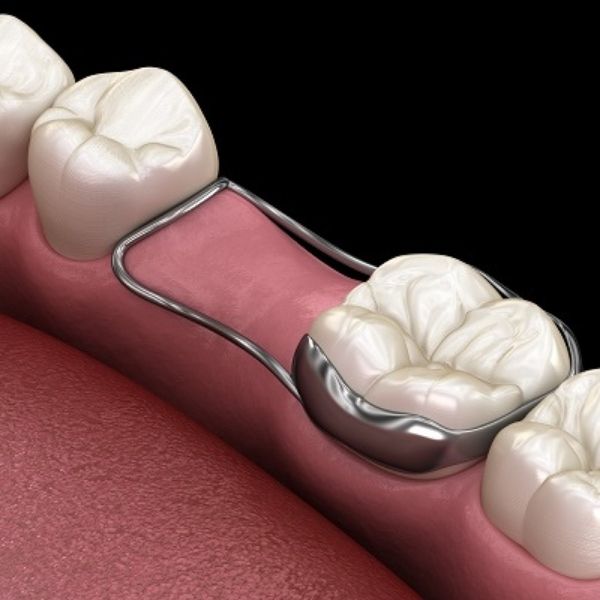
Think of a space maintainer as a "parking spot holder" for your child's permanent tooth that's still developing under the gums. These small, custom-made appliances keep the neighboring teeth from drifting into the gap left by a lost baby tooth. Baby teeth aren't just placeholders—they guide permanent teeth into their correct positions. When a baby tooth is lost prematurely (more than a year before it would naturally fall out), the teeth on either side tend to lean or shift into that empty space within just 6-12 months.
Space maintainers prevent this drift and preserve the proper space until the permanent tooth is ready to erupt, usually saving your family thousands of dollars in future orthodontic treatment. Most children wear space maintainers for several months to a few years, depending on when the permanent tooth is expected to come in.
There are different types of space maintainers—some are cemented in place (fixed), while others can be removed for cleaning (removable). Your dentist will recommend the best type based on which tooth was lost, your child's age, and their ability to care for a removable appliance.
At Dental Sedation Ottawa, we understand that even simple dental procedures can feel overwhelming for anxious children. Whether your child needs one space maintainer or is receiving other treatments at the same time, we prioritize comfort through comprehensive sedation dentistry options.
Mild relaxation for cooperative children with minimal anxiety. Your child stays awake and aware, breathing through a small mask. Effects wear off within minutes after the mask is removed.
Learn more about nitrous oxide →Medication taken about an hour before the appointment creates drowsiness and reduces anxiety. Great for moderately nervous children or longer appointments. Your child remains responsive but deeply relaxed.
Explore oral sedation →Deeper sedation administered through a tiny IV line provides continuous relaxation throughout treatment, with our team monitoring your child constantly. Ideal for high anxiety or when multiple procedures need to be completed.
Discover IV sedation →Complete, peaceful sleep with zero awareness or memory of the procedure. Administered by board-certified medical anesthesiologists (Dr. Hesham Talab, MD MSc PhD FRCPC FASE and Dr. Asad Mirghassemi, MD MSc FRCPC). Best for severe dental anxiety, very young children, special needs patients, or when extensive treatment is needed. Hospital-grade safety protocols right in our dental clinic.
Learn about general anesthesia →With appropriate sedation, especially IV sedation or general anesthesia, we can place space maintainers along with other needed treatments—fillings, crowns, extractions—all in a single appointment. This means fewer dental visits, one recovery period, and significantly less stress for your entire family.
Questions? We're here to help.
Not every lost baby tooth requires a space maintainer. Dentists typically recommend them in specific situations where premature tooth loss threatens proper dental development.
Severe Tooth Decay: When cavities damage a baby tooth so extensively that it must be extracted, particularly back molars that won't naturally fall out for several more years.
Dental Trauma or Injury: Accidents, falls, or sports injuries that knock out or severely damage a baby tooth well before its expected natural loss.
Congenitally Missing Teeth: Some children are born without certain permanent teeth developing. A space maintainer holds the space until orthodontic treatment or other solutions can be planned.
Early Natural Loss: Occasionally baby teeth fall out much earlier than expected due to unusual root resorption or other factors, creating premature space loss risk.
After Pulpotomy or Pulpectomy Failure: When nerve treatment doesn't save a badly decayed baby tooth and extraction becomes necessary.
Your dentist will take X-rays to see how close the permanent tooth is to erupting and assess whether neighboring teeth have space to drift. This evaluation determines whether a space maintainer is truly necessary for your child.
Ready to take the next step? Our team is here for you.
These are the most common type for children because they can't be lost, don't require daily removal, and work continuously. Fixed maintainers are cemented onto teeth adjacent to the empty space.
Band and Loop: The most frequently used maintainer, ideal when one baby tooth is lost. A stainless steel band fits around the tooth behind the space, with a wire loop extending forward to touch the tooth in front, holding both teeth in position.
Lingual Arch: Used when multiple back teeth on one side are missing. A wire spans along the inside (tongue side) of the lower teeth, attached to bands on the back molars on both sides.
Distal Shoe: A specialized maintainer used when a baby molar is lost before the permanent first molar has erupted. A metal extension guides the permanent molar into proper position as it comes in.
Similar to a small partial denture or retainer, removable maintainers have an acrylic base that sits against the roof of the mouth or along the gums, with wire clasps that grip surrounding teeth. Sometimes they include a false tooth to fill the space for appearance and function. These work well for older, responsible children who can remove them for cleaning and remember to wear them consistently.
Your dentist will recommend the best type based on your child's age, the location and number of missing teeth, oral hygiene habits, and ability to manage a removable appliance.
Have questions? We'd love to hear from you.
Before the appointment, we examine your child's mouth, take X-rays to assess permanent tooth development, and discuss which type of space maintainer will work best. We also talk through sedation options based on your child's anxiety level and whether other treatments are needed during the same visit.
On treatment day, we begin by administering your chosen sedation option. Once your child is comfortable and relaxed (or peacefully asleep with general anesthesia), we ensure complete numbness if any tooth preparation is required. Throughout the procedure, our team continuously monitors your child for safety.
For fixed maintainers, the dentist first cleans and dries the anchor tooth (or teeth). If using a band-and-loop design, a stainless steel band is carefully fitted around the tooth behind the space, similar to how an orthodontic band fits. The wire loop is shaped to touch the tooth in front of the space gently, then the band is cemented permanently in place. For lingual arches, bands go on both back molars with a wire connecting them along the inside of the lower teeth.
For removable maintainers, we take impressions (molds) of your child's teeth at the first visit, and a dental laboratory fabricates the custom appliance. At the second visit, we fit and adjust it for comfort, then teach your child and you how to insert, remove, and clean it properly.
Fixed maintainer placement typically takes 20-30 minutes. If combined with extractions or other procedures under sedation, total appointment time extends accordingly. Removable maintainers require two visits—impressions at the first (15 minutes) and delivery/fitting at the second (20-30 minutes).
Ready to get started?
Your child will adapt to the space maintainer within a few days. Initially it may feel strange or cause minor speech changes, but these resolve quickly. The maintainer stays in place doing its job silently—most children forget it's there. Regular X-rays every 6-12 months track the permanent tooth's development. When X-rays show the permanent tooth is about to erupt (usually visible just under the gums), we remove the maintainer in a quick, painless appointment.
Have questions? We'd love to hear from you.
Per appliance
This one-time investment often prevents $3,000-8,000 in future orthodontic treatment costs by maintaining proper tooth alignment and spacing.
Most pediatric dental insurance plans cover space maintainers at 50-80% when medically necessary to prevent crowding or misalignment. We provide direct billing to major insurance carriers and accept the Canadian Dental Care Plan (CDCP).
When you consider the alternative—allowing teeth to drift and later requiring braces, extractions, or other orthodontic interventions to create space—space maintainers represent exceptional preventive value. The small upfront cost protects your child's dental development and can save your family thousands in the long run.
We also offer flexible payment options and can discuss financing through third-party providers to make care accessible. Our team reviews your insurance coverage and direct billing options during your consultation.
Parents trust us with their children's dental care.
Read More Reviews on GoogleDentist Referrals Welcome: We collaborate with referring dentists and orthodontists throughout Ottawa and Eastern Ontario for pediatric space maintainer cases.
Learn About Our Referral Process