Tongue Tie Release (Lingual Frenectomy) in Ottawa

Expert Treatment for Restricted Tongue Movement — From Newborns Through Children

Book a ConsultationCall (613) 482-0501

Tongue Tie Release for Infants and Children

A tongue tie (ankyloglossia) occurs when the lingual frenum — a small tissue band under the tongue — is too short or tight, restricting normal tongue movement. This seemingly minor condition can create significant challenges: breastfeeding difficulties in newborns, maternal nipple pain and injury, speech delays and articulation problems in older children, and difficulty with chewing, swallowing, and oral hygiene. At Dental Sedation Ottawa, we perform precise lingual frenectomy procedures that immediately release the restriction and restore normal tongue function — with comprehensive sedation ensuring complete comfort from birth through childhood.
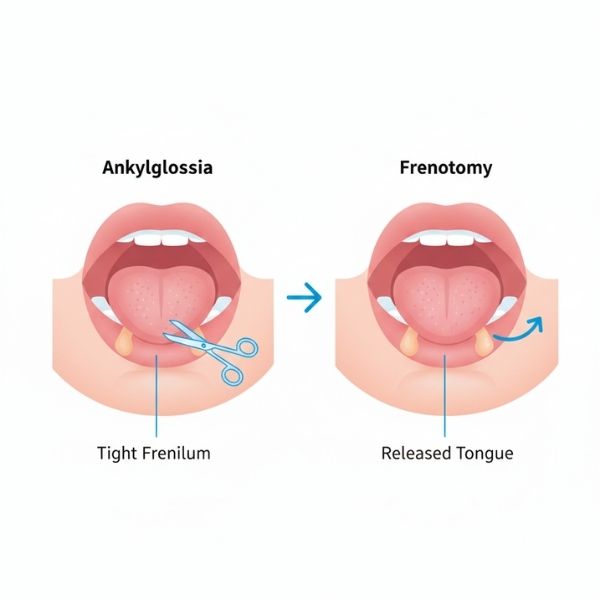
Gentle tongue tie release procedure at Dental Sedation Ottawa

What Is Tongue Tie (Ankyloglossia)?

Tongue tie, medically known as ankyloglossia, occurs when the lingual frenum — a small fold of tissue under the tongue that connects the underside of the tongue to the floor of the mouth — is too short, too tight, or attached too high (close to the tongue tip). When the frenum is excessively restrictive, it prevents the tongue from moving through its full range of motion.

The tongue's mobility is essential for countless functions: breastfeeding (the tongue must rise to form a seal and move in complex patterns), bottle feeding (tongue positioning affects suction and swallowing), speech (proper tongue placement is crucial for articulating many consonant sounds), eating and chewing (tongue movement is necessary for food manipulation), and general oral function.

Tongue ties are classified by severity — from mild (causing minimal functional impairment) to severe (creating substantial feeding, speech, and oral health problems). The severity is determined not only by how tight the frenum is, but also by how it affects the individual child's ability to feed, speak, and function.

Importantly, not every tight frenum needs to be released. A tongue tie only requires treatment when it causes documented functional problems: feeding difficulties, maternal pain, speech delays, dental spacing issues, or other functional limitations. Our evaluation process thoroughly assesses whether your child's specific tongue tie requires treatment.

Making Tongue Tie Release Stress-Free

Our sedation options ensure complete comfort — from newborns through older children.

Topical Anesthesia Only (Newborns)

For very young infants (typically under 4 months), we perform tongue tie release using only topical numbing gel. The procedure is quick (1-3 minutes) and many babies sleep through it. Parents can nurse immediately afterward.

Nitrous Oxide (Laughing Gas)

Mild relaxation for cooperative toddlers and children with minimal anxiety. Your child breathes through a comfortable nose mask, feels calm, but remains fully awake.

Learn more →

Oral Sedation

Medication administered before the appointment creates drowsiness and significantly reduces anxiety. Excellent for moderately anxious toddlers and young children.

Learn more →

IV Sedation

Deeper sedation for high anxiety, very young toddlers, or complex releases. Continuous monitoring ensures safety. Your child awakens quickly with no memory of the procedure.

Learn more →

General Anesthesia

Complete, peaceful sleep with zero awareness. Administered by board-certified medical anesthesiologists. Hospital-grade safety in our dental office.

Learn more →

Signs Your Baby or Child May Have Tongue Tie

Common symptoms that may indicate a tongue tie:

Feeding Problems (Infants): Difficulty latching onto breast or bottle, clicking or popping sounds while feeding, frequent breaking of suction, baby tiring quickly, poor weight gain, prolonged feeding times (45+ minutes), maternal nipple pain, cracked or bleeding nipples
Speech & Oral Function Delays (Children): Difficulty pronouncing consonant sounds (especially l, r, t, d, n, th, s, z), muffled or unclear speech, tongue cannot extend past lower front teeth, heart-shaped or notched tongue tip, difficulty licking lips, problems with chewing and moving food
Dental & Structural Issues: Wide gap (diastema) between upper front teeth, gum recession on lower front teeth, difficulty with oral hygiene
Associated Concerns: Mouth breathing instead of nasal breathing, sleep-disordered breathing or snoring, chronic digestive issues (reflux, gas, colic in infants), social anxiety about speaking

Understanding Tongue Tie Classification

Tongue ties vary significantly in severity, appearance, and functional impact.

Type I (Complete Anterior)

The frenum extends all the way to the tongue tip, completely restricting movement. Highly visible and obvious. Usually causes significant feeding and speech problems. Benefits substantially from early release.

Type II (Partial Anterior)

The frenum attaches about halfway between the tongue tip and the base. Clearly visible and usually causes moderate to significant functional problems. The most common type requiring treatment.

Type III (Posterior)

The frenum attachment is under the tongue toward the base, not easily visible from above. Can still significantly restrict tongue function despite being less obvious. Sometimes missed in initial evaluations.

The Tongue Tie Release Procedure

Evaluation and Assessment

Comprehensive evaluation including visual and functional assessment of the tongue tie, discussion of feeding or speech concerns, review of medical history, and sedation planning. For infants with breastfeeding challenges, we coordinate with lactation consultants when possible.

Sedation and Preparation

We administer your chosen sedation option — topical numbing, nitrous oxide, oral sedation, IV sedation, or general anesthesia. Once your child is comfortable, we ensure complete numbness of the surgical area.

The Release

Dr. Koniouchine uses surgical scissors or a scalpel to carefully incise the frenum, releasing the restriction. For simple, thin frenums, this takes just 1-3 minutes. More complex cases with thick tissue may require slightly more extensive release and possibly 1-3 dissolvable stitches. Bleeding is typically minimal.

Immediate Aftercare

Your child awakens gradually if sedated. We apply gentle pressure with gauze to control any bleeding (usually stops within 1-2 minutes). For breastfed infants, nursing immediately is encouraged — it helps comfort the baby and supports healing.

Healing After Tongue Tie Release

Immediate Recovery (First 24-48 Hours): Discomfort is typically minimal — most children need only children's acetaminophen or ibuprofen for 1-2 days. The surgical site may appear white or yellowish (normal granulation tissue, not infection). Minor bleeding can occur if the area is disturbed.

For Infants: Nurse or bottle feed frequently — the sucking motion promotes healing and provides comfort. Expect some fussiness for 24-48 hours. You may notice improved latch and feeding efficiency within hours to days. Some infants experience a brief nursing strike (1-2 days) while adjusting to new tongue mobility.

For Older Children: Stick to soft, cool foods for 2-3 days (yogurt, applesauce, smoothies). Avoid hard, crunchy, spicy, or acidic foods. Gentle oral hygiene, avoiding direct brushing of the surgical area for the first few days.

Essential Stretching Exercises: To prevent frenum reattachment during healing (which happens in 5-10% of cases without exercises), we teach specific stretching exercises performed 2-4 times daily for 2-4 weeks. These involve gently lifting the tongue to stretch where the frenum was released. We demonstrate thoroughly and provide written instructions.

Speech Therapy: Infants released in the first few months typically develop normal speech without formal therapy. Older children (18 months and beyond) may benefit from 4-8 sessions of speech therapy to retrain muscle patterns. Therapy typically begins 2-4 weeks after release.

Complete Healing: The frenectomy site heals completely within 2-3 weeks. Functional improvements continue over weeks to months as your child learns to use their newly mobile tongue effectively.

What Improves After Tongue Tie Release

Life-changing improvements for babies, children, and families

For Breastfed Infants

Improved latch and suction efficiency, elimination of clicking sounds while nursing, better milk transfer and reduced feeding time, faster weight gain, elimination of maternal nipple pain, reduced reflux and colic symptoms, prevention of early weaning.

For Older Children

Clearer articulation and improved speech quality, ability to produce previously difficult sounds, better oral hygiene ability, improved chewing and swallowing, reduced mouth breathing, enhanced self-confidence about speaking, potential natural closure of gaps between front teeth.

For Families

Reduced stress around feeding difficulties, elimination of chronic nipple pain for nursing mothers, avoidance of supplemental feeding needs, prevention of extensive speech therapy, potential reduction in orthodontic treatment needs, overall improved quality of life.

Affordable Investment in Your Child's Health

Transparent pricing for tongue tie release procedures

Simple Release (Topical)

$300–$400. With topical anesthesia only. For straightforward, thin tongue ties in newborns and young infants.

Release with Sedation

$500–$800. For more complex cases or those requiring nitrous oxide, oral sedation, IV sedation, or general anesthesia.

Combined Treatment

Tongue tie release with other dental work in one sedated appointment for better value and fewer visits.

Sedation Fees

Nitrous oxide $75–$150. Oral sedation $150–$300. IV sedation $500–$900. General anesthesia $1,000–$1,800.

Insurance and Payment Options

Many dental and health insurance plans cover tongue tie release at 50–80% when deemed medically necessary.

We provide direct billing to major insurance carriers and accept the Canadian Dental Care Plan (CDCP).

Flexible payment options available.

Real Experiences from Ottawa Families

★★★★★ 5.0 out of 5 stars · 300+ reviews

Our patients consistently rate us 5 stars for gentle, anxiety-free care. Read verified patient experiences on Google.

View All Reviews on Google

Why Families Choose Dental Sedation Ottawa for Tongue Tie Release

Expert care for your child's tongue tie:

Expert Pediatric Specialist: Dr. Anatolij Koniouchine with extensive experience and hundreds of successful tongue tie releases
Full Sedation Range: From topical anesthesia for newborns to general anesthesia for anxious children
Board-Certified Anesthesiologists: Hospital-grade safety with Dr. Hesham Talab and Dr. Asad Mirghassemi
Quick Procedure: Simple tongue tie releases take just 1-3 minutes, minimizing discomfort and recovery
Lactation Consultant Coordination: Comprehensive infant feeding support before and after release
Combined Treatment Capability: Can address multiple dental needs in one sedated visit
Comprehensive Aftercare: Detailed stretching exercise instruction and follow-up support to prevent reattachment
Multilingual services: English, French, Ukrainian, Russian, Arabic
Insurance coordination and CDCP coverage with direct billing
Referrals welcome: we collaborate with pediatricians, lactation consultants, and speech therapists — learn about our referral program

Ready to Help Your Child Thrive?

Whether your newborn is struggling with breastfeeding or your child is experiencing speech challenges due to tongue tie, our expert team can help. Contact us today.

Request a ConsultationCall (613) 482-0501
Call Now Directions