When your jawbone doesn't have enough volume or density to support dental implants, bone grafting rebuilds that foundation. It's a common, well-established procedure — and at Dental Sedation Ottawa, it's one we perform regularly under IV sedation or general anesthesia, so even patients who feel anxious about additional surgery can have it done comfortably and without stress. Bone grafting has a success rate exceeding 90%, and for many patients it's the essential step that makes implant treatment possible.
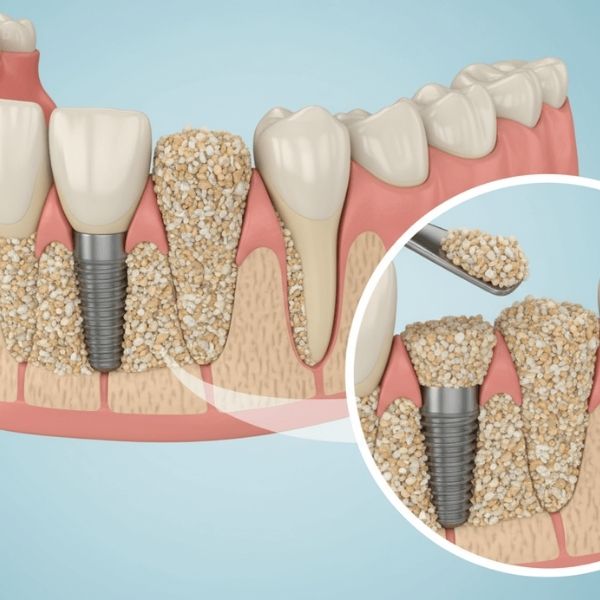
Your jawbone is a living tissue that needs stimulation from tooth roots to maintain its volume. When teeth are lost — whether from extraction, decay, trauma, or gum disease — the bone that supported those teeth begins to resorb. Within the first year after tooth loss, you can lose up to 25% of bone width in that area, and the deterioration continues over time.
This is why bone grafting is so commonly paired with dental implant treatment. If you've had teeth missing for months or years, if you've worn dentures that accelerate bone loss, or if periodontal disease has eroded the bone around your remaining teeth, there may simply not be enough bone left to anchor an implant securely.
Bone grafting addresses this by adding bone material to the deficient area. Over a period of months, your body integrates this grafted material and grows new, natural bone — creating a solid, living foundation that can support dental implants for decades. Without this step, implants placed in insufficient bone have a much higher risk of failure.
The most common reasons patients need bone grafting include: bone loss from long-term missing teeth, damage from advanced periodontal disease, bone resorption under poorly fitting dentures, bone loss after traumatic tooth loss, and preparation for sinus lift procedures in the upper jaw.
For many patients, learning they need bone grafting on top of implant surgery feels overwhelming. Our sedation options exist specifically to eliminate that worry.
Bone grafting isn't a one-size-fits-all procedure. The approach depends on where the bone loss is, how severe it is, and what we're preparing for.
Harvested from another site in your mouth (chin, back of the jaw) or occasionally from your hip. Contains living bone cells and growth factors, making it the gold standard for bone regeneration. Used when maximum predictability is needed.
Processed human bone from a tissue bank. All cellular material is removed, leaving only the mineral scaffold. Eliminates the need for a second surgical site in your mouth. The most commonly used graft material in dental practice.
Typically bovine (cow) bone that has been thoroughly processed to remove all organic material. Maintains excellent structural properties and integrates well. Often used for socket preservation and ridge augmentation.
Manufactured bone substitute materials including hydroxyapatite, tricalcium phosphate, and bioactive glass. Eliminates any concerns about donor material. In many cases, a combination of materials is used — for example, mixing allograft particulate with your own bone harvested during the procedure.
We start with a comprehensive examination including 3D cone beam CT scan, which shows us the exact dimensions of your existing bone. We measure where bone is deficient, plan the grafting approach, and discuss your sedation options.
If you're having IV sedation or general anesthesia, you'll receive fasting instructions. We'll review your medical history and any medications. For oral sedation, you'll take your prescribed medication before arriving.
Under your chosen sedation, we access the bone through a small incision in the gum tissue. The graft material is placed precisely where needed, shaped to create the right contour, and often covered with a protective membrane. The site is then closed with sutures. Most grafting procedures take 45-90 minutes.
You'll go home the same day with detailed aftercare instructions. Expect some swelling and mild discomfort for 3-5 days, easily managed with prescribed medication. Sutures typically dissolve or are removed within 7-14 days.
Over the next 3-6 months, your body replaces the graft material with your own natural bone. We monitor this process with periodic check-ups and imaging. Once integration is confirmed, you're ready for implant placement.
The first 48-72 hours after bone grafting involve the most noticeable recovery. Swelling typically peaks on day 2-3 and begins subsiding by day 4-5. We prescribe appropriate pain medication, and most patients report that discomfort is milder than expected — comparable to a tooth extraction.
During the first week, stick to soft foods and avoid chewing near the graft site. Avoid using straws, smoking, and vigorous rinsing, as these can disturb the graft. Starting on day 2, gentle warm salt water rinses help keep the area clean.
Most patients return to work within 2-3 days. Physical exercise should be limited for the first week. The external visible healing (gum tissue closing over the graft) typically completes within 2-3 weeks.
The invisible healing — bone integration — takes 3-6 months depending on the type and extent of grafting. During this time, the grafted material gradually transforms into your own living bone. We track this progress and let you know when it's safe to proceed with implant placement.
Bone grafting may be recommended if:
Bone grafting costs depend on the type and extent of the procedure.
Bone grafting is often partially covered by dental insurance when medically necessary.
We provide direct billing to major insurance companies and accept the Canadian Dental Care Plan (CDCP).
Flexible financing available through third-party providers.
Our patients consistently rate us 5 stars for gentle, anxiety-free care. Read verified patient experiences on Google.
View All Reviews on GoogleWhy patients choose Dental Sedation Ottawa for bone grafting: